
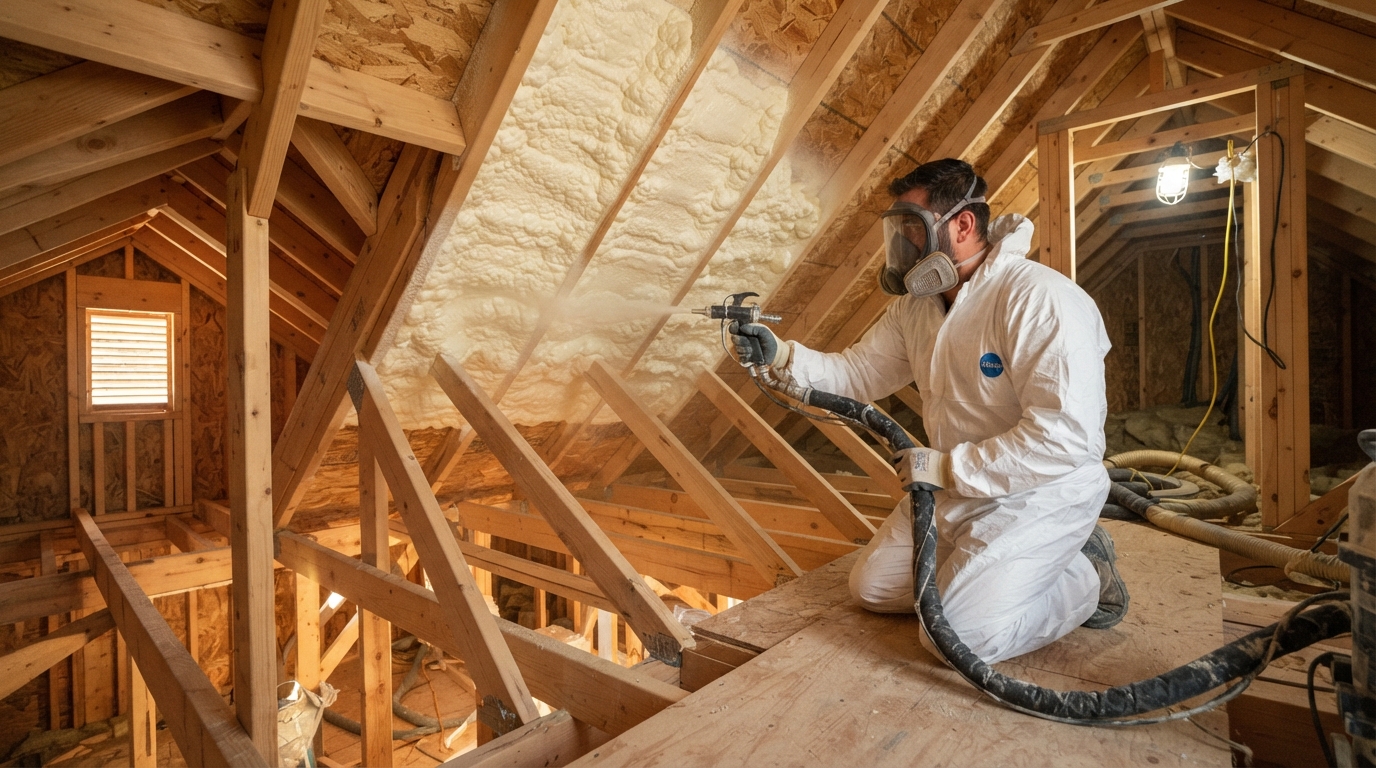
• Spray foam insulation seals air leaks and adds thermal resistance in one application, which is useful in the humid, high-heat climate typical of the Gulf South.
• Attics and exterior walls are the two areas where sealing gaps tends to produce the most noticeable comfort and moisture-control improvement.
• Local installers familiar with Louisiana building conditions can assess whether open-cell or closed-cell foam fits a specific wall cavity or roofline.
Spray foam insulation works by expanding into cavities and hardening into an air-sealed barrier, which limits heat transfer and reduces the air leakage that drives up cooling costs in warm, humid regions. Unlike batt or blown-in materials that only slow heat flow, foam also blocks moving air and the moisture it carries.
Residential Spray Foam Insulation is typically applied in two forms: open-cell foam, which is lighter and more flexible for interior walls, and closed-cell foam, which is denser and adds some structural rigidity along with a higher R-value per inch. Choosing between them depends on the cavity depth, moisture exposure, and whether the area is conditioned living space or an unconditioned attic.
Why Attics and Walls Respond Differently to Foam
Attics in East Baton Rouge Parish, LA face direct sun exposure for much of the year, which pushes roof deck temperatures well above outdoor air temperature. Spray foam applied along the roofline, rather than the attic floor, can convert the attic into a semi-conditioned space that stays closer to indoor temperature.
Exterior walls behave differently because they deal with wind-driven rain and humidity infiltration rather than radiant heat alone. Closed-cell foam’s resistance to water absorption makes it a common choice for wall cavities in climates where humidity control matters as much as temperature control, a point echoed in federal guidance on home insulation materials.
Comparing Common Insulation Types
|
Insulation Type |
Air Sealing |
Typical R-Value per Inch |
Moisture Resistance |
|
Open-cell spray foam |
High |
3.5 to 3.6 |
Moderate |
|
Closed-cell spray foam |
High |
6.0 to 6.5 |
High |
|
Fiberglass batt |
Low |
2.9 to 3.8 |
Low |
|
Blown-in cellulose |
Low to moderate |
3.2 to 3.8 |
Low |
The table reflects general industry ranges rather than results for any specific installation, since actual performance depends on application thickness and cavity conditions.
Regional Factors Worth Considering
Homes in East Baton Rouge Parish, LA often combine older wall framing with additions or renovations, which can leave gaps around plumbing penetrations, electrical boxes, and band joists. These gaps are common entry points for humid outdoor air, and sealing them is frequently part of a broader insulation upgrade rather than a standalone step.
A few practical considerations for homeowners evaluating the work:
• Roofline application in vented versus unvented attics requires different foam thicknities and, in some cases, different moisture management details.
• Older homes may need an inspection for existing moisture damage before foam is installed, since sealing over a wet cavity can mask rather than resolve a problem.
• Local permitting and building code requirements can affect which foam type is approved for specific wall or attic assemblies.
Based in Zachary, LA, Thermo-Guard Industrial, LLC extends its service area to include customers throughout East Baton Rouge Parish, LA.
Frequently Asked Questions
Does spray foam insulation reduce humidity indoors? It can help indirectly by limiting the infiltration of humid outdoor air through wall and attic gaps, though it is not a substitute for a dedicated dehumidification or HVAC system.
Is open-cell or closed-cell foam better for a hot, humid climate? Closed-cell foam’s lower water absorption makes it a frequent choice for exterior walls and roof decks in humid regions, while open-cell foam is sometimes used in interior partitions where moisture exposure is lower.
Can spray foam be added to an existing attic without removing old insulation? In many cases a contractor can evaluate the existing material and roofline condition first, since foam performance depends on proper surface contact and ventilation planning.
How does spray foam affect energy bills? Sealing air leaks and adding thermal resistance can lower the energy needed for heating and cooling, though actual savings vary by home size, existing insulation levels, and HVAC equipment condition.
Final Notes and Business Information
Evaluating spray foam for a specific home typically starts with an inspection of the attic roofline, wall cavities, and any existing moisture issues before a foam type is recommended. Homeowners researching local installers can review verified business details through the Thermo-Guard Industrial, LLC Google Business Profile.
Current service details for Thermo-Guard Industrial, LLC are listed for the local service area.