
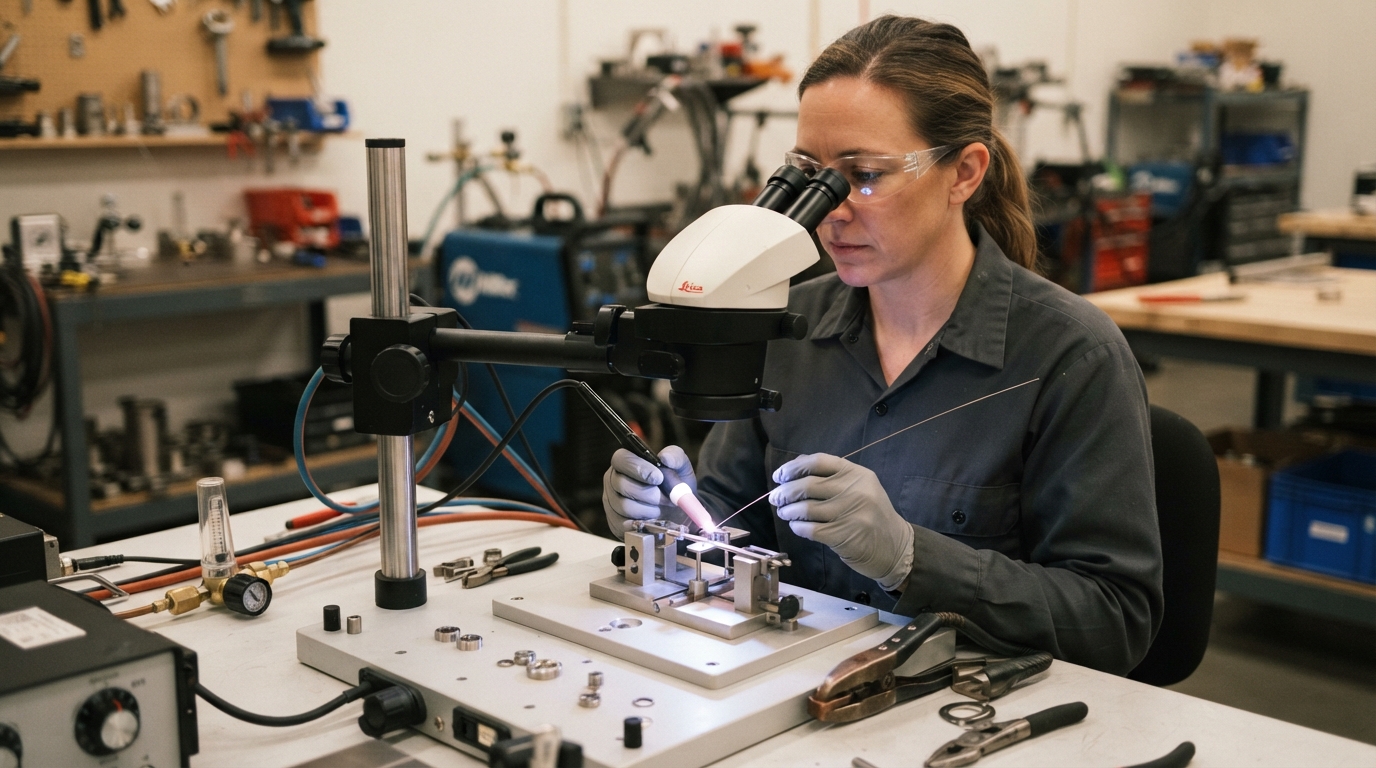
• Micro TIG welding joins small, delicate metal components with low amperage and minimal heat, reducing distortion on fine parts.
• The process supports medical devices, mold repair, electronics, and other precision applications where standard welding is too aggressive.
• Shops across the USA use microscopic TIG welding to repair or fabricate parts measured in millimeters or micrometers.
Micro TIG welding is a precision joining process that uses a finely controlled tungsten electrode and low amperage to weld small, delicate, or intricate metal parts with minimal heat distortion. It is best suited for components where standard welding methods risk warping, discoloring, or damaging fine details.
The process is typically performed under magnification, which lets a welder see features too small for the naked eye. Micro TIG Welding relies on this visual control paired with reduced current to fuse tiny joints without compromising surrounding material. Industry sources describe microscopic TIG welding as an advanced technique used to join extremely small and delicate metal components with high precision, performed under a microscope for unparalleled accuracy.
How Microscopic TIG Welding Differs From Standard TIG
Standard TIG welding is built for larger assemblies and thicker material sections. Micro TIG scales the same gas tungsten arc welding principle down to a fraction of the current and heat input.
• Electrode and filler size : Fine tungsten electrodes and ultra-thin filler wire are used to accommodate micro-scale welds.
• Heat control : Lower heat settings prevent distortion and damage to delicate components.
• Weld scale : Microscopic TIG welding deals with incredibly small, delicate components, often measured in millimeters or even micrometers, requiring an exceptional level of precision and control.
A related industry overview classifies the micro-TIG process category as having weld areas under 18 mm² and a current range of 5 to 300 amps, which illustrates how narrow the operating window is compared to conventional welding equipment. For a broader technical reference on gas tungsten arc welding fundamentals, the American Welding Society publishes standards and educational materials relevant to GTAW practices used in micro-scale work.
Where Fine Metalwork Benefits Most
Several industries depend on microscopic TIG welding because standard methods introduce too much heat or lack the precision needed for small features.
|
Application Area |
Why Micro TIG Fits |
|
Medical device components |
Tight tolerances and heat-sensitive materials require minimal distortion |
|
Mold and die repair |
Fine detail restoration without reworking the entire tool |
|
Firearm components |
Small parts need durable, precise joints |
|
Electronics and connectors |
Delicate wiring and contacts cannot tolerate excess heat |
Micro Weld Inc provides microscopic TIG welding for medical devices, molds, firearm components, and industrial parts. The gas and oil sector also uses the process for targeted repairs rather than full part replacement, since the gas and oil industry relies on microscopic TIG welding for pipeline and equipment repairs, ensuring safety and reliability.
Practical Advantages Over Replacement or Standard Welding
Choosing micro TIG welding over remaking a part or using conventional welding often comes down to cost, turnaround, and preserved tolerances.
1. Minimal heat-affected zones reduce the risk of warping thin or intricate sections.
2. Lower cost than remaking a part , since damaged areas can be repaired instead of replaced.
3. Filler compatibility , since microscopic TIG is usually the better fit when a part needs filler material added, or when the joint doesn’t fit perfectly.
4. Trained operator requirement , as welders and operators should be adequately trained and certified to perform microscopic TIG welding, adhering to industry standards.
This combination of precision and repairability is why manufacturers across the USA turn to the process for parts that cannot be reworked with heavier welding equipment.
Frequently Asked Questions
Is micro TIG welding the same as laser welding? No. Micro TIG welding uses a fine tungsten electrode to produce extremely precise welds through a controlled arc process, while laser welding uses a focused light beam instead of an arc.
What materials can be joined with micro TIG welding? The process is suitable for a wide range of metals, including stainless steel, aluminum, and exotic alloys.
Does micro TIG welding require filler material? It can. The torch and filler rod are used under magnification, since the TIG welding service happens under a microscope, even though it uses a torch and filler rod.
Why is heat control so important in this process? Low heat input limits stress and distortion on small parts, since due to the lower heat input, micro TIG welding introduces less stress into the part.
Business Info
Micro Weld, Inc. is a welding service provider offering microscopic TIG welding for medical devices, molds, firearm components, and industrial parts, with Click here for micro tig welding outlining the process in more detail.
Published details for Click here for micro tig welding cover the service area for microscopic welding work.
Micro TIG welding remains a practical option for fine metalwork where precision, repairability, and controlled heat input matter more than speed or scale, making it a dependable process for small, detailed components produced or repaired throughout the USA.